Tessellarium
Overview
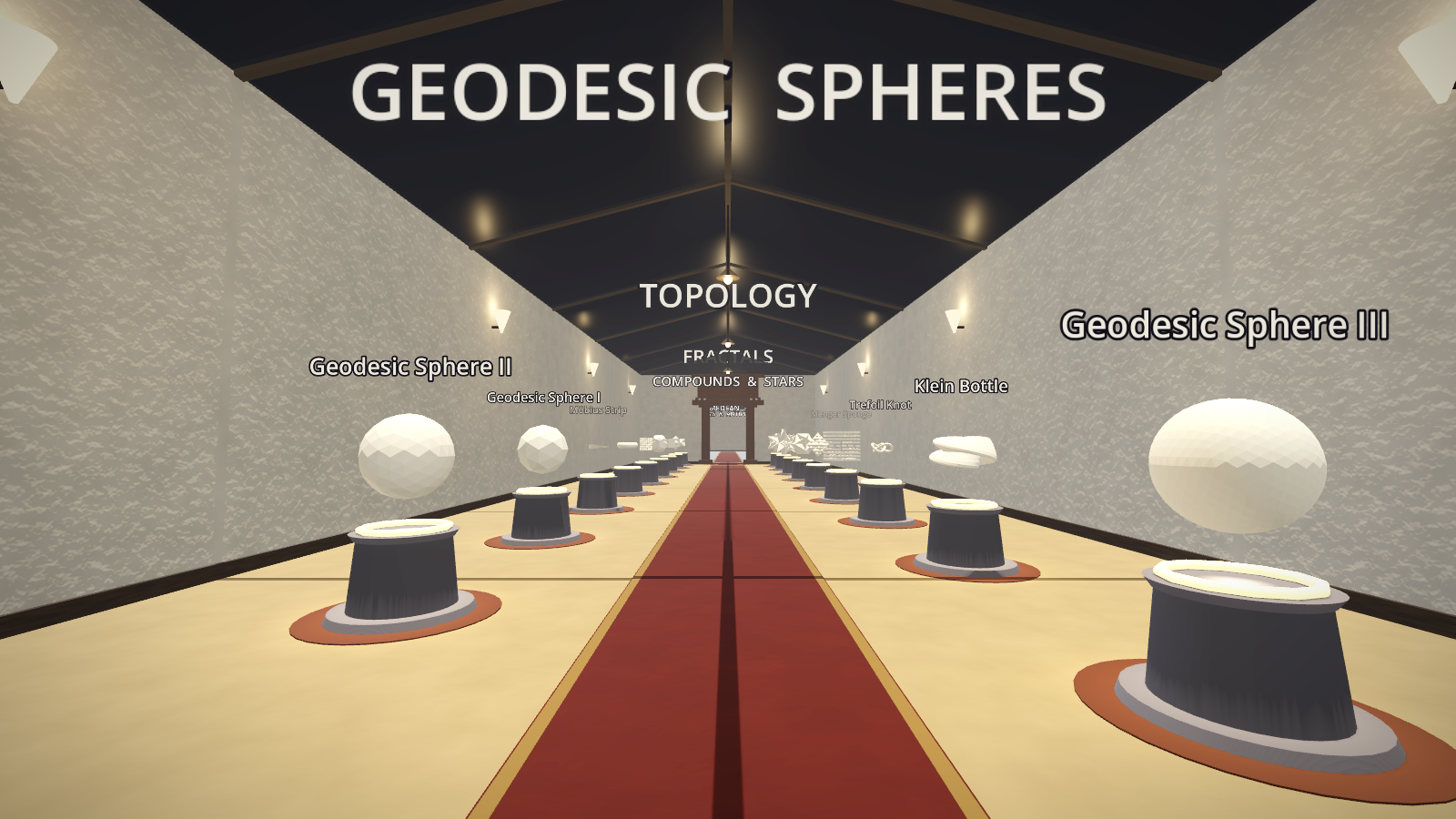
A museum-like space for exploring some of the wonders of geometry and math.
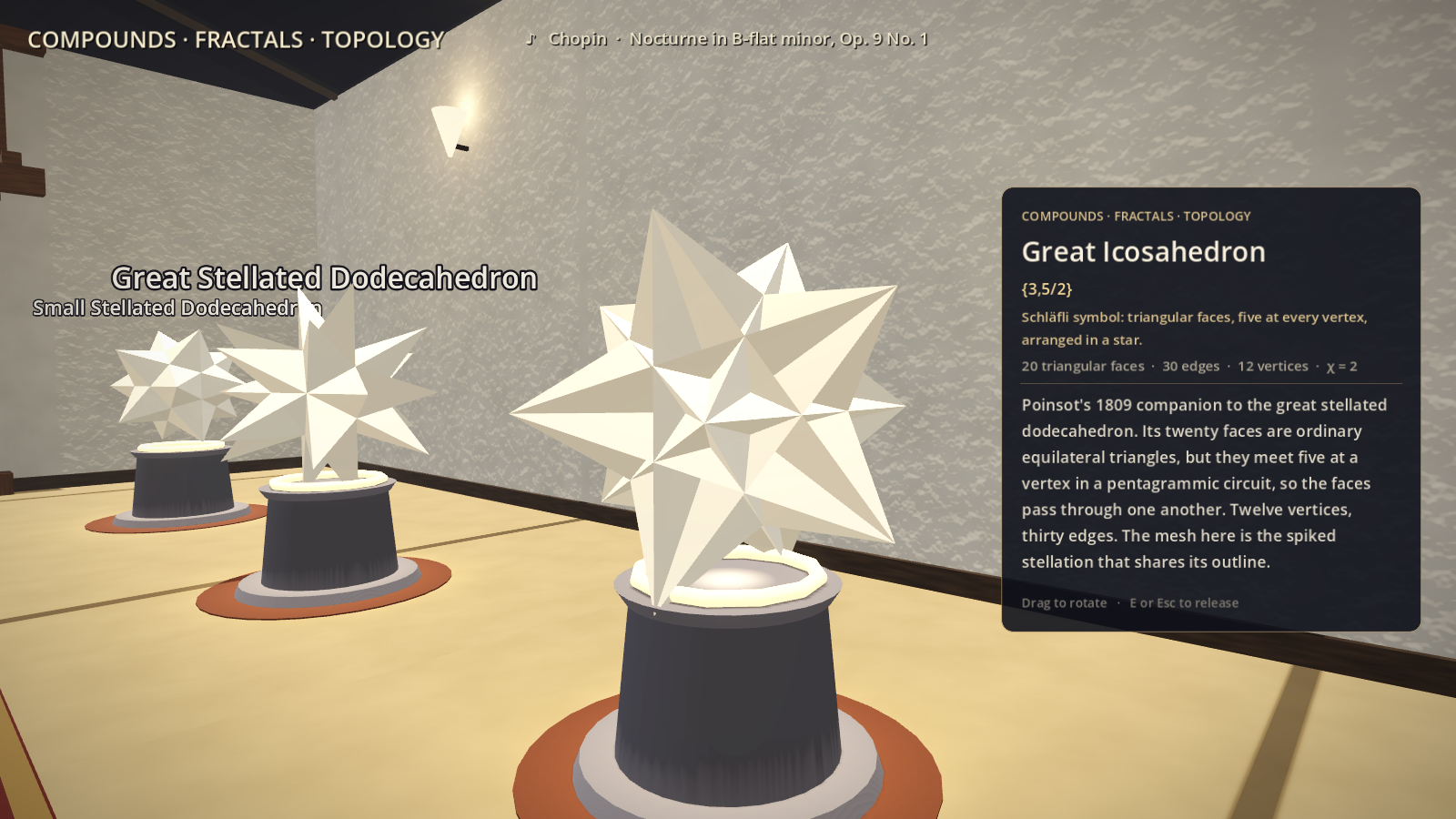
The player has tools for examining shapes by applying overlays, rotating them, turning on party mode :), and cloning and tossing them around too (just in case you ever wanted to make it rain Great Stellated Dodecahedrons).
The collection
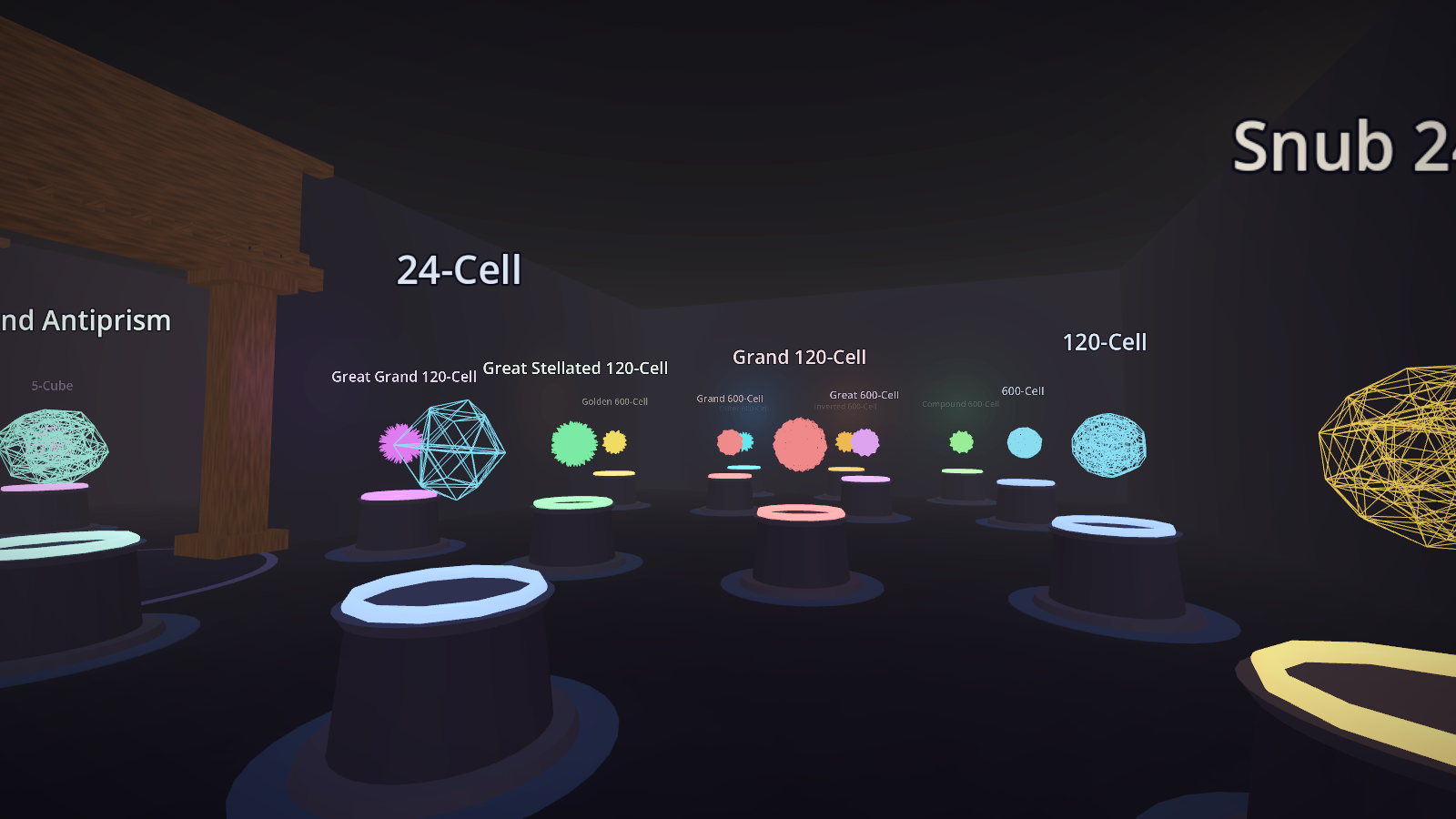
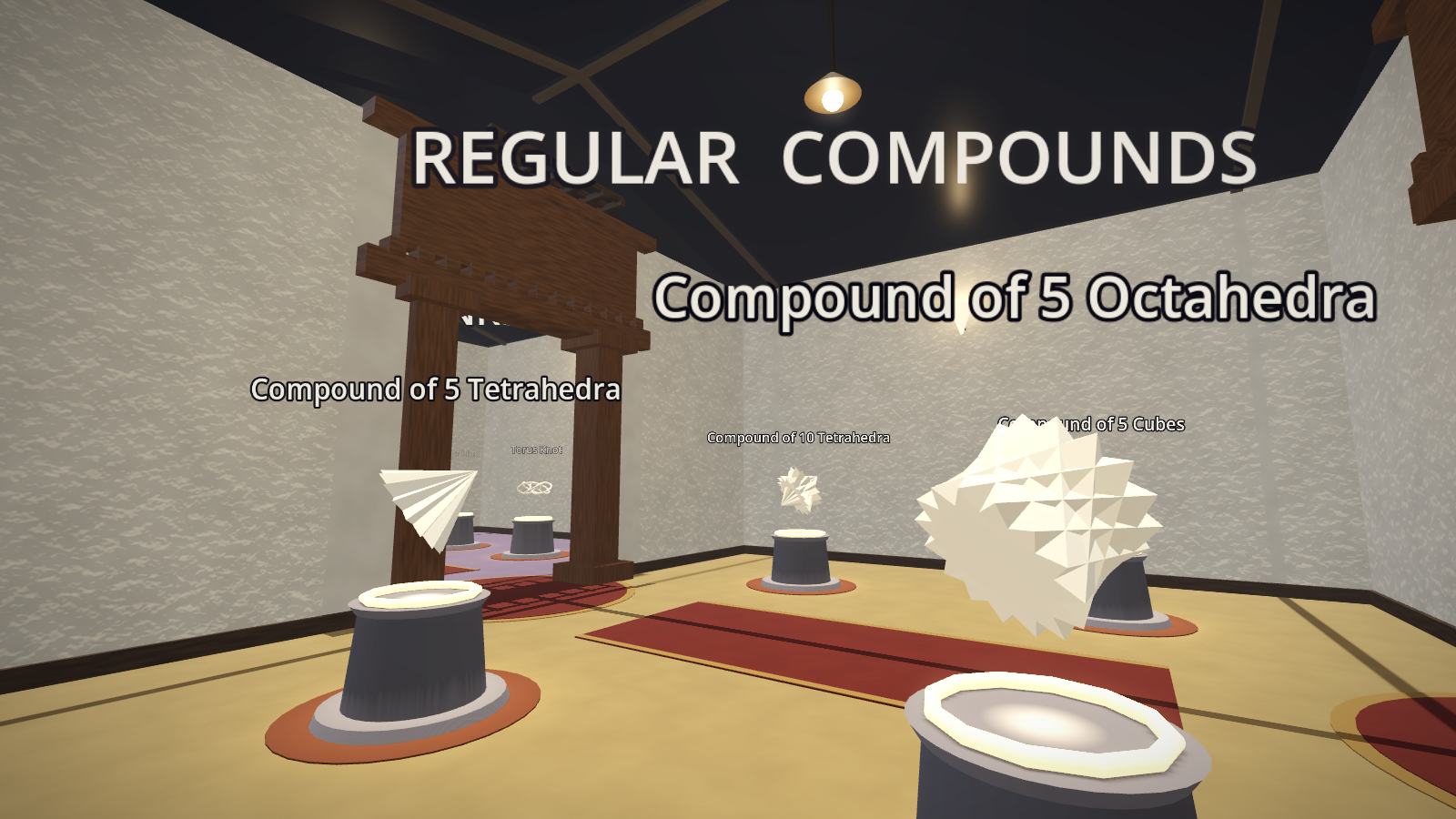
183 exhibits across 37 rooms.
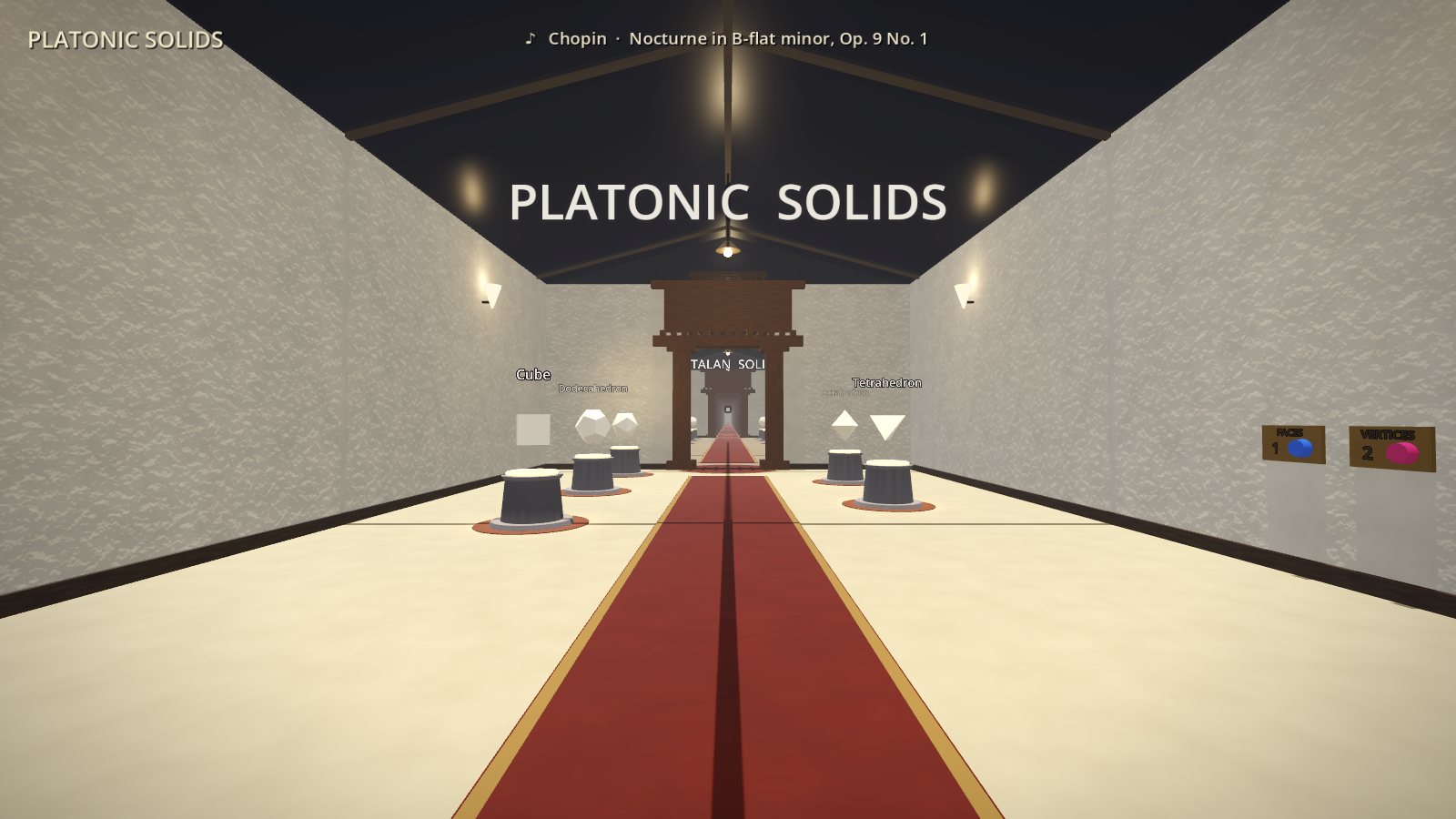
- The Platonic room — the five regular convex solids, where everything begins.
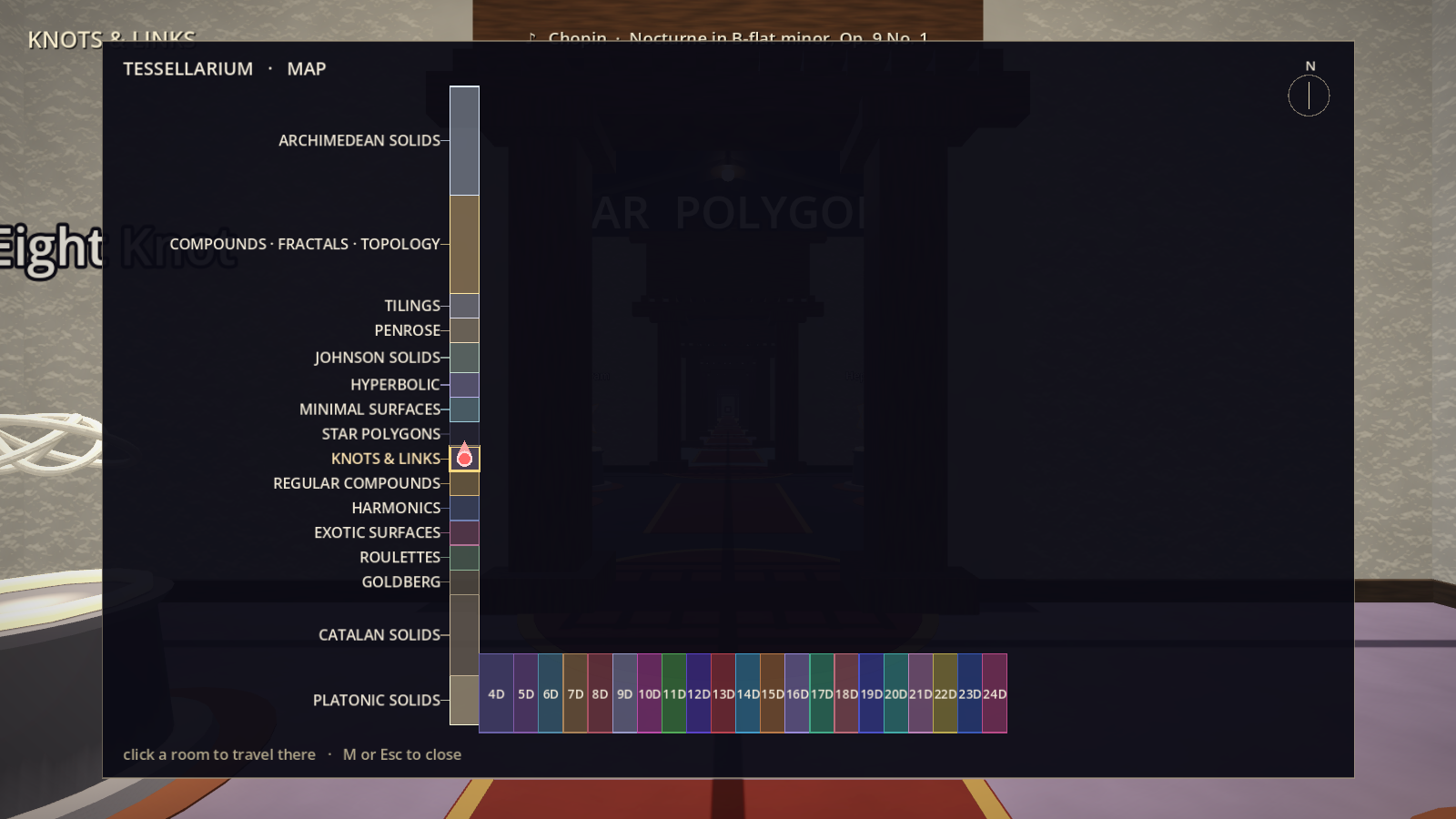
- The spine runs north: the Catalan duals, Goldberg polyhedra, roulette curves, exotic surfaces, spherical harmonics, the regular compounds, knots and links, star polygons, minimal and hyperbolic surfaces, a few Johnson solids, the Penrose tiling and the regular plane tilings, a long room of compounds, fractals and topological surfaces, and finally the Archimedean solids with the prisms and antiprisms.
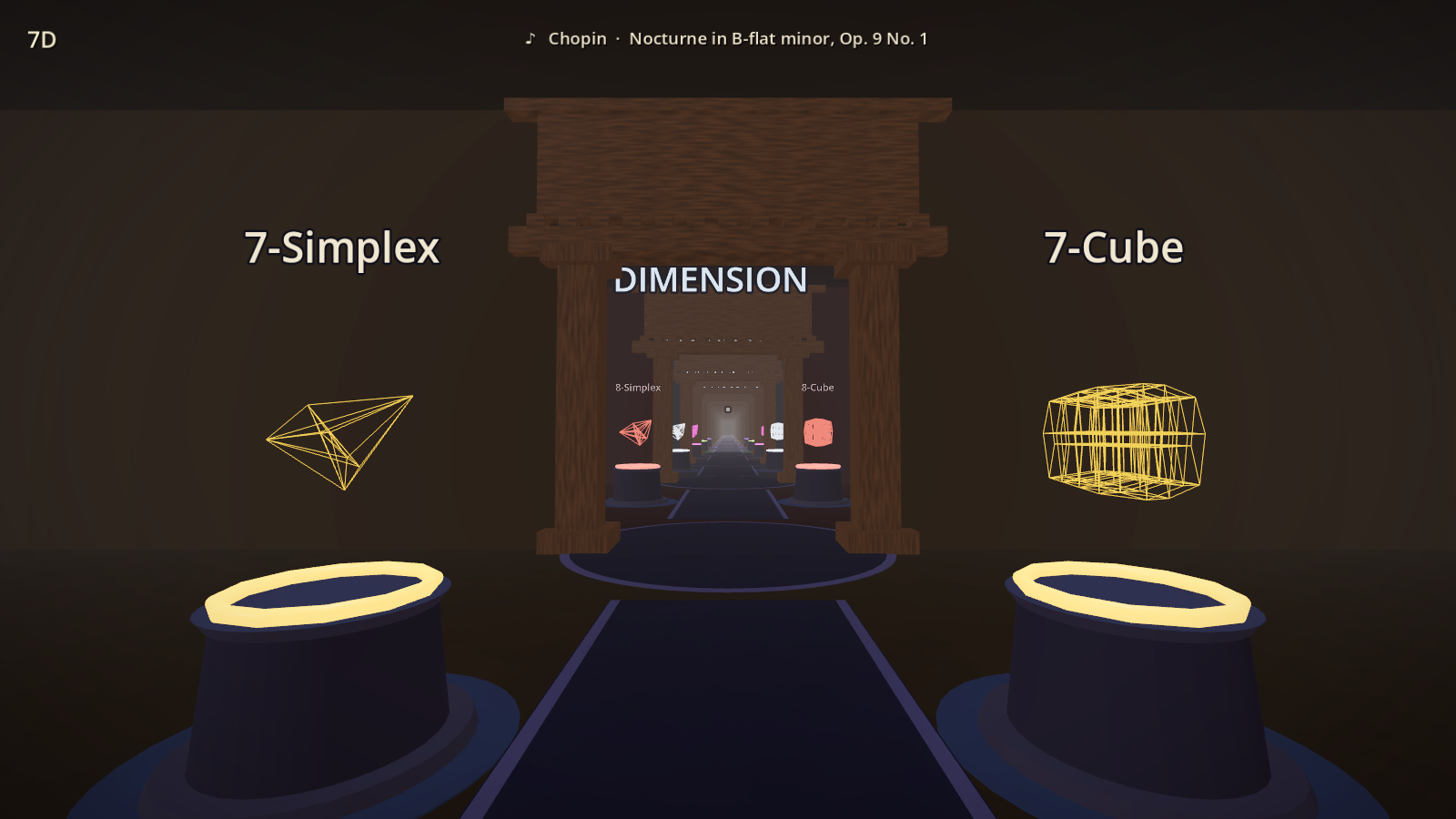
- The east wing holds the polytopes: the six regular convex 4-polytopes and a handful of stars, then one room per dimension from five to twenty-four, each shape projected stepwise back into the three dimensions you can walk around in.
What you can do
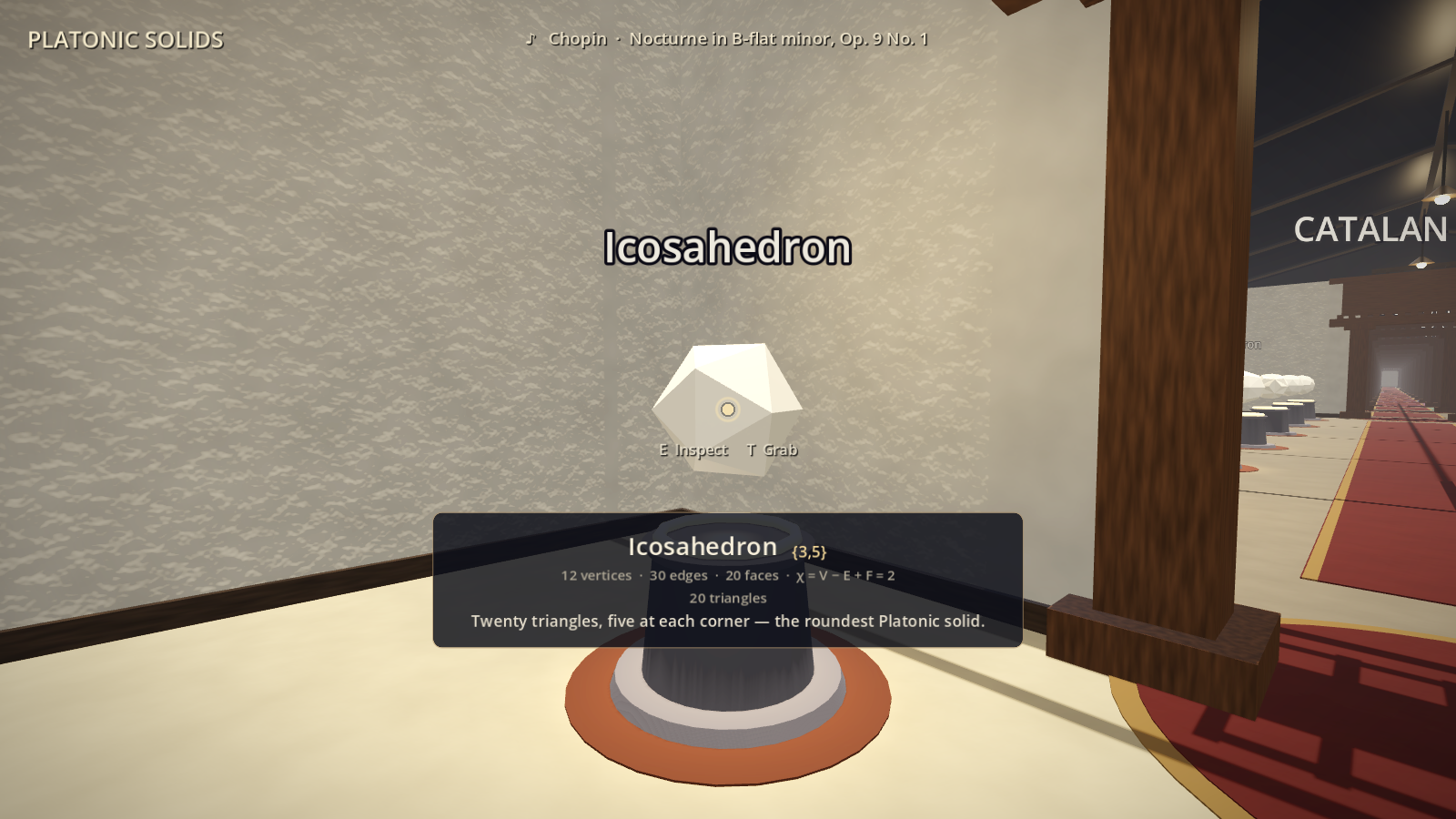
- Read the placards. Look at any shape for its name, notation and counts — vertices, edges, faces, Euler characteristic, face composition — and a line on what it is.
- Inspect. Press E and the shape lifts off its pedestal so you can turn it in your hands. Polytopes come with preset poses; from six dimensions up, the scroll wheel drives a third rotation plane.
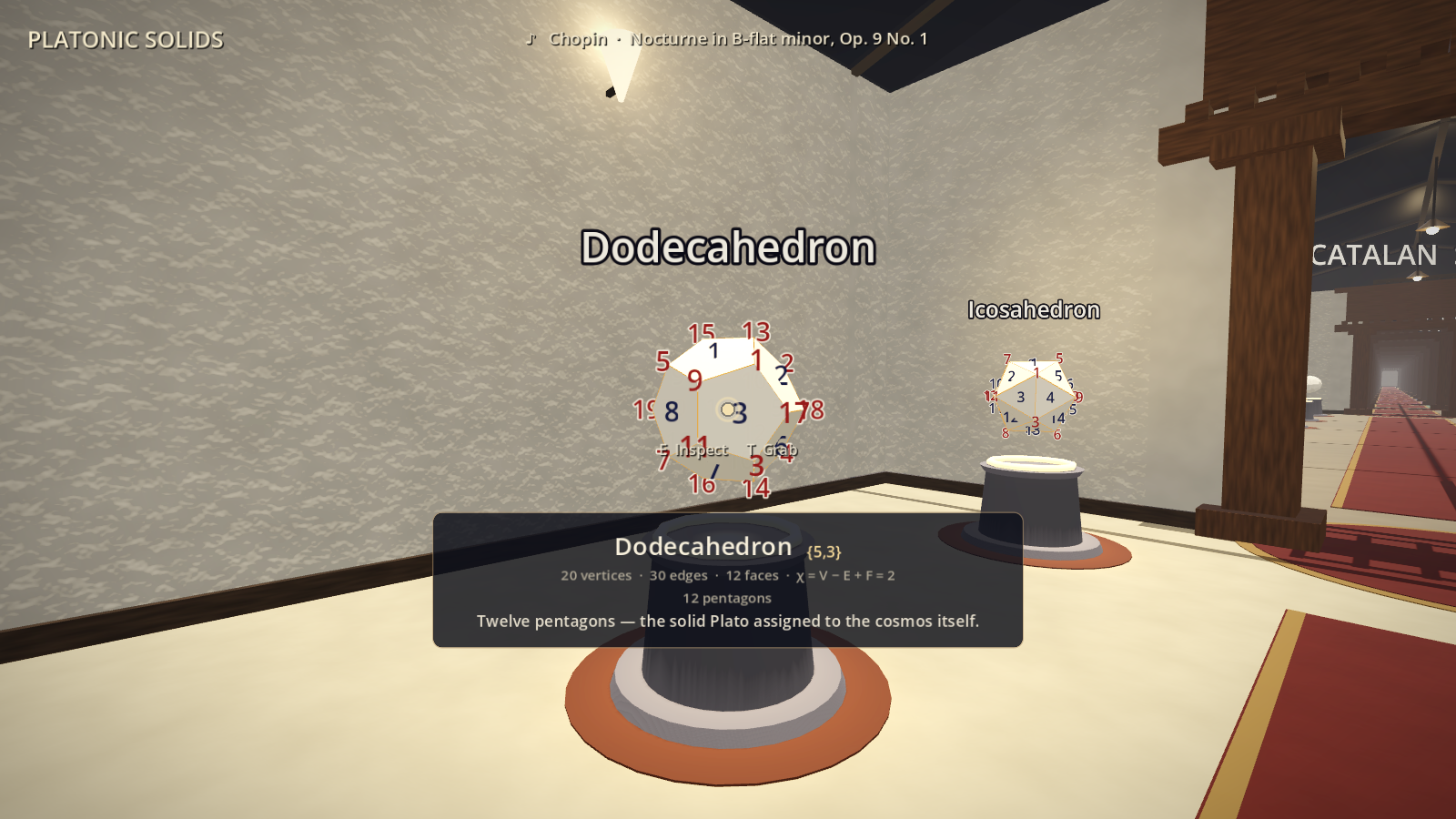
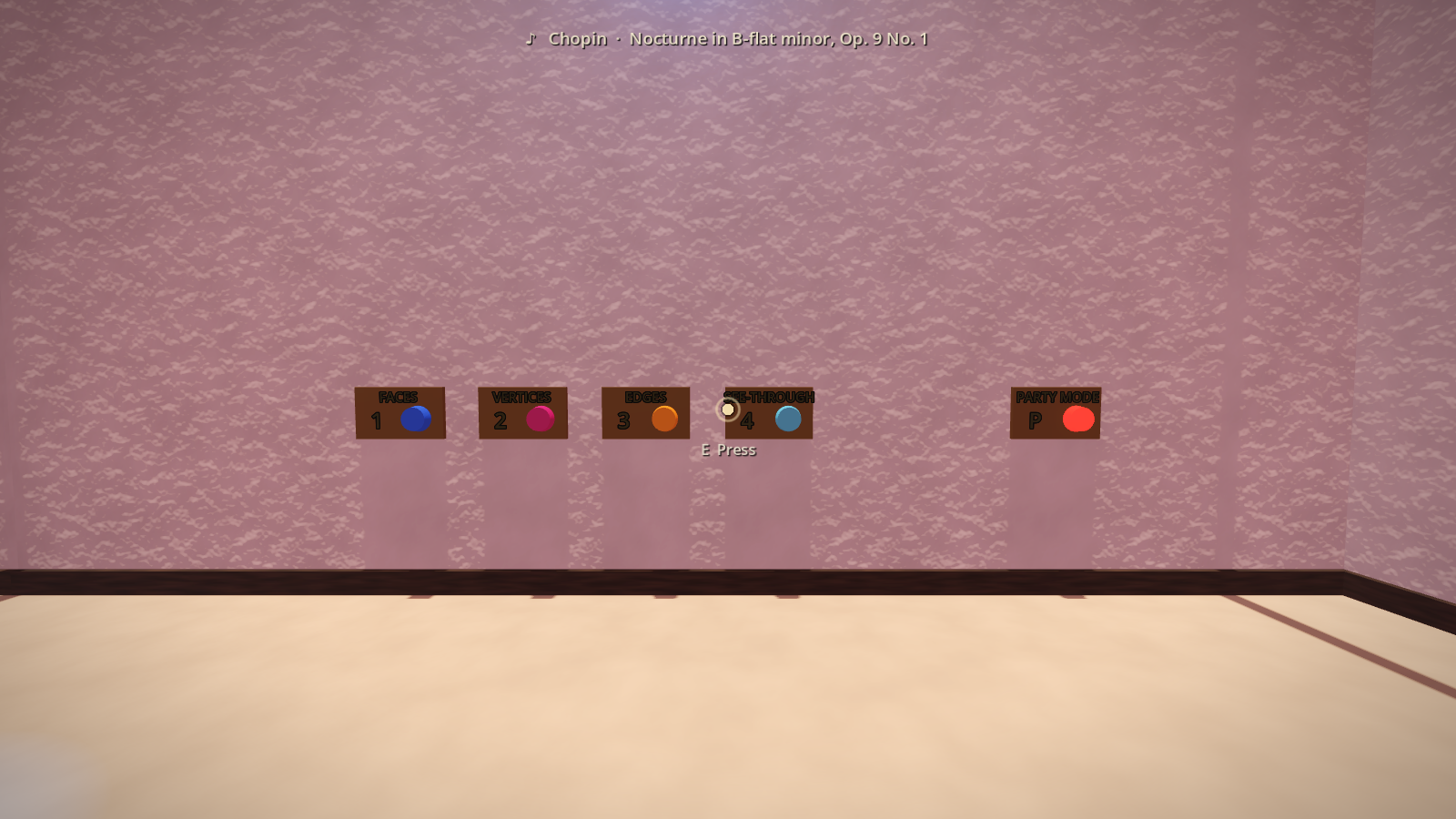
- Study the structure. Number every face and every vertex and trace every edge — the overlays switch on for the pedestals around you (1 / 2 / 3), so you can check the counts on the placard against the shape itself. Make the surfaces see-through (4) to follow edges through the interior.
- Pick things up. Grab a copy of any shape (T), then place it or throw it. Physics included.
- Get around. Walk, sprint, jump — or double-tap Space to fly. Open the map (M) and click a room to travel there.
- Just look. Hide the labels (L) or the whole HUD (H). Switch on a flashlight (Q) to pick a shape out of a dark room.
- Find the buttons. A row of them on the wall of the first room works the overlays, and the red one at the end changes the museum.
Keyboard and mouse, with partial gamepad support. Settings — sensitivity, field of view, volume, shadows, haze — are remembered between visits. About half an hour to walk it all; nothing to win.
Music
Chopin's Nocturnes Op. 9 (1830–32), in recordings released under Public Domain Mark 1.0 via musopen.org: No. 1 in B-flat minor (Olga Gurevich), No. 2 in E-flat major (Aya Higuchi), No. 3 in B major (Xuan He). V pauses the music; N skips to the next nocturne.
Credits
Design, code and 3D mathematics: Quantum Ape Studios, 2026. Built with Godot 4.6, an open-source engine. Sound: Sonniss #GameAudioGDC bundle (royalty-free), Kenney.nl (CC0), and in-house synthesis. Free to play, free to share.
Feedback: feedback@quantumapestudios.com — or leave a comment below.
Development log
- Tessellarium is live8 days ago
Leave a comment
Log in with itch.io to leave a comment.